
College Station City Directory Collections
College Station city directories are part of a Bryan-College Station shelf, not a single uninterrupted local series. The local house-history guide says surviving directories begin in 1937. The Texas State Library and Archives Commission lists a later set with specific gaps, while the Carnegie History Center keeps city directories among its local-history resources. Begin by writing down the year needed and the type of search, name or street, before asking for a volume. That small preparation helps staff distinguish a directory from a telephone book, newspaper, or map.
| Collection | Years | Where Held | Access |
|---|---|---|---|
| Bryan-College Station city directories | Surviving from 1937; listed runs span 1951-52 through 1994 with gaps | Carnegie History Center; Texas State Library holdings | Reference help and in-person name or street searches |
| Polk Bryan-College Station directory | At least 1969 cataloged | Texas State Library catalog; verify local volume availability | Check the title page before assigning a publisher to another year |
| Telephone books | Scattered to the 1920s, often surname-only | Carnegie and Texas A&M collections | Useful, incomplete household or business clue |
| Texas A&M Olio yearbooks | 1895, then annual from 1903 as digitization permits | Cushing Memorial Library & Archives | Digital and archive context for students and organizations |
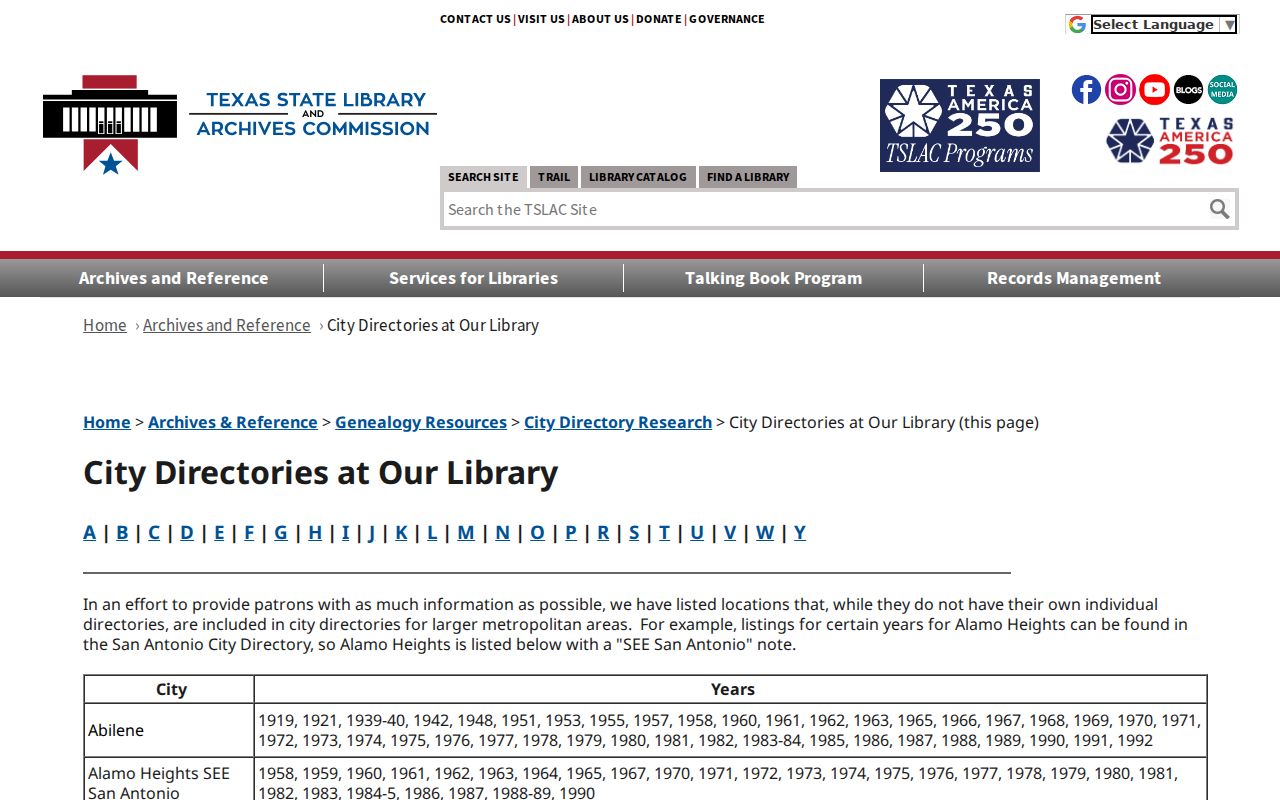
The documented Texas State Library years are 1951-52, 1953-54, 1957-58, 1963, 1965, 1967, 1969, 1971, 1972, 1974-76, 1978-86, 1988-89, 1991, 1993, and 1994. A missing year is not proof that no directory was issued or that no person lived here. It means the available holdings need a shelf check. The local library does not publish a complete online inventory or a private resident index.
College Station Directory Years and Gaps
Use the 1969 Polk attribution carefully. State-library catalog material identifies that Bryan-College Station volume as published by R.L. Polk & Co., but the research does not verify Polk for every listed year. Publisher, layout, and abbreviations can change from one title to another. Photograph or note the title page, date, and page number when a result matters. That citation is more useful later than a bare name copied from a page.
- 1937: The local house-history guide identifies this as the start of surviving Bryan-College Station directories.
- 1951-52 to 1994: Texas State Library holdings document selected Bryan-College Station runs, with gaps between several editions.
- 1969: R.L. Polk & Co. is verified for the cataloged volume, not assumed for the rest of the series.
Older county research may require a different path. Texas State Library and Texas A&M microfilm preserve Brazos County series that the modern online index does not fully describe. Deed records begin in 1841, and tax rolls run from 1842 to 1910 on microfilm. Those sources can help bracket a directory lead, but they do not replace the city directory’s street-order view of a community.
Note: Record the exact volume consulted because collection gaps and title changes can make a negative name search hard to interpret later.
Carnegie's College Station Directory Shelf
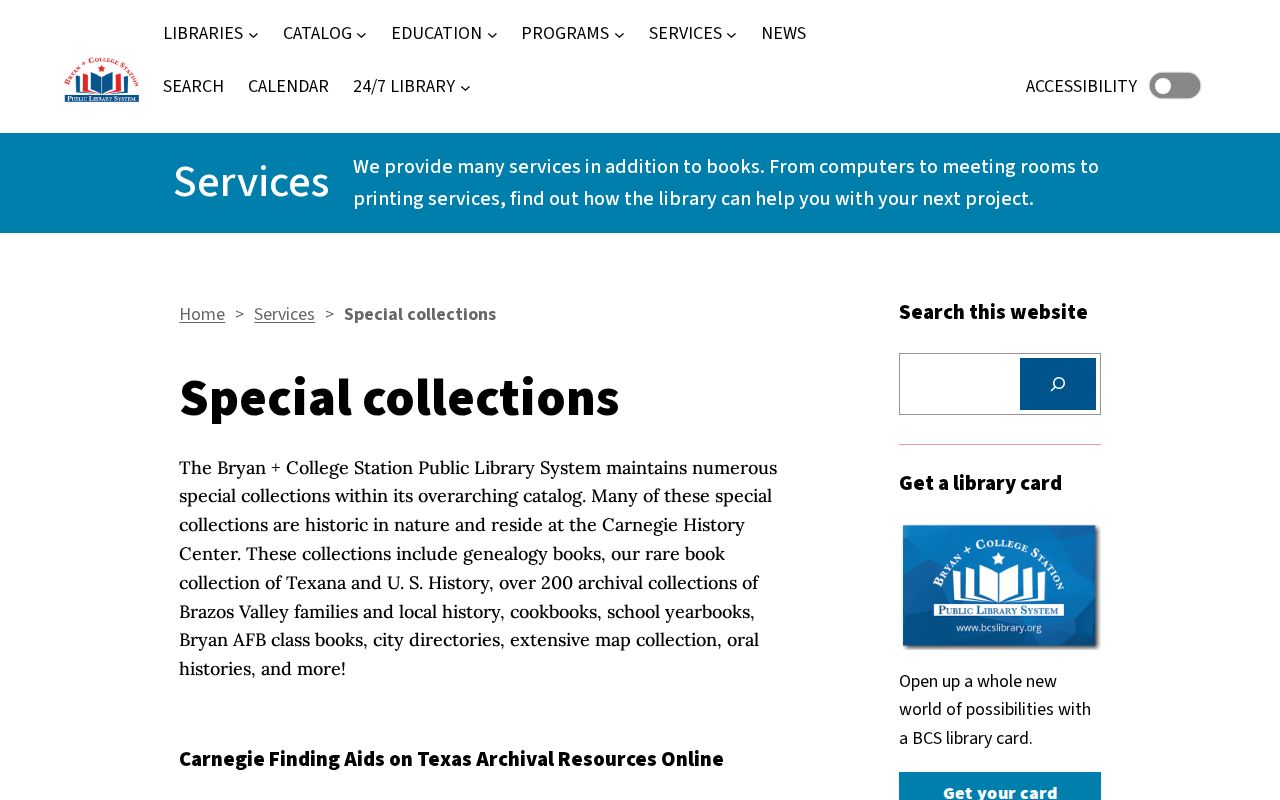
The Carnegie History Center is the main local shelf for College Station city directory research. Its Special Collections describe more than 200 archival collections, plus city directories, telephone directories, maps, yearbooks, oral histories, newspapers, rare Texana, and local family materials. The center has microfilm and microfiche equipment, a DigiLab, free computers, and finding aids through the Texas Archival Resources Online network. Staff can help turn an old street name, owner surname, approximate date, or obituary date into a focused request.
The Carnegie History Center special-collections page shows the local-history setting for the College Station city directory shelf.
Its accompanying collections are useful when the directory alone is thin. NewsBank offers The Eagle from 1999 forward for cardholders, while older Eagle issues are on Carnegie microfilm. Heritage Hub supplies obituary and death-notice images. Neither service is a substitute for the directory, yet each can test whether a move, death, organization, or family connection explains a change in the printed listing.
Reading a College Station City Directory Entry
Read a College Station city directory as a lead sheet, not as final proof. The local guide documents alphabetical name entries, street addresses, occupations, and, in some years, household size or another family clue. The street listing places nearby residents and businesses in address order. Some volumes may add a spouse or relative, widow notation, an owner, householder, or renter marker, and a business classification. Telephone information may appear in a telephone book or directory volume, but early books are often surname-only.
| Alphabetical name | Identifies the person under the spelling used by that volume. |
|---|---|
| Street address | Connects the entry to the street-order listing and nearby entries. |
| Occupation | Provides a business or identity lead that can distinguish similar names. |
| Household clue | May include a spouse, relative, widow notation, household size, or status marker, depending on the year. |
| Street sequence | Shows neighbors and businesses in order for a reverse lookup. |
An actual scanned Bryan-College Station entry and its abbreviation key were not exposed in the reviewed official web material. Do not assign a local meaning to a mark without seeing that volume’s key. A directory can keep an old address, omit someone, or use a short form that changes between publishers.
- Criss-cross directory
- The street-order portion of a directory, used to work from an address toward listed occupants and nearby entries.
- Householder index
- An index organized around the listed household head, which may not include every person present.
- Abbreviation key
- The volume’s own explanation of shortened labels and marks. Check it before interpreting a status notation.
College Station City Directories at Cushing
Texas A&M collections provide a useful companion when a College Station city directory touches campus life or an older College Station address. Cushing Memorial Library & Archives holds Texas A&M catalogs beginning in 1876, historical images, Brazos County and Texas maps, newspapers and periodicals, and Olio yearbooks. The Olio is online from 1895 and annual from 1903 through the current era as digitization permits. A yearbook can supply a student name, organization, photo, residence-hall clue, or class context that a commercial directory may leave out.
The Texas State Library city-directory holdings list is the starting point for checking the documented Bryan-College Station years before a visit.
Cushing is at 400 Spence Street in College Station and can be reached at 979-845-1951. Use university materials as historical context, not as a current resident list. A campus catalog, yearbook, county deed, and city directory may refer to the same person or building with different identifiers, so preserve the original name and address wording from each source.
For modern address-keyed records, use the College Station street directory approach after the historical volume has supplied a street or parcel lead.
College Station Directory Maps and Buildings
Sanborn maps can answer a different question from College Station city directories. The Library of Congress provides the Bryan, Brazos County run for July 1938 through March 1950, 36 sheets, with College Station listed as a secondary location. A sheet can show a building footprint, construction material, number of stories, fire walls, street names, and some public or commercial uses. It generally does not identify an occupant.
The Brazos County Historical Commission page provides the local heritage context shown with this College Station city directory research.
Use a deed, directory, newspaper, census, or obituary to connect a building to a person. The Library of Congress Sanborn map record supplies building-level evidence, while the Historical Commission can route local-history questions. The reviewed information did not identify a public name index or research-service fee. Historic map research is strongest when it joins a map’s structure detail to a separately documented person or transfer.
Note: Sanborn sheets establish building context, not a complete list of residents or proof that a named person occupied the structure.
Tracing a College Station Directory Household
Follow a household in the College Station city directories one edition at a time. Start with the street section if an address is known, then use the alphabetical section to capture the form of the name used that year. Copy the address, occupation, family clue, phone, status mark, and nearby listings. A surname may move even when an address does not, and a new spouse surname or widow notation may bridge a change. Keep the directory year beside every fact rather than folding several years into one undated note.
- Write down each street-number, directional, suffix, route, and unit variation found in the available records.
- Search the street section and the alphabetical name section, then preserve the neighboring entries and any family or identity clues.
- Compare the address with the CAD situs and mailing fields, the deed legal description, and historic map or annexation layers.
- For a move, search the surname in the next available directory and test initials, a new surname, and a business address.
- Pair the directory year with the 1930, 1940, or 1950 census release and relevant newspapers, deeds, probate, permits, or construction changes.
A disappearance can mean a move, death, omission, renamed address, altered publication cycle, or missing volume. Keep negative results. They show which years and spellings have already been tested and prevent a later researcher from treating a collection gap as a personal fact.
College Station Directory History in Context
College Station’s record trail crosses campus, Bryan, county, and city descriptions. Texas A&M opened in 1876, the postal designation followed in 1877, and incorporation came on October 19, 1938. The first council met in 1939, and home rule followed in 1952. Pre-incorporation or early material can therefore use Bryan, a rural precinct, a campus-area place, or railroad-station language instead of a current College Station form.
City landmark material adds a local scale: 109 campus houses existed in 1938, early College Park and Oakwood homes were occupied in 1939, and campus houses were sold from 1941 through 1972. A current parcel may preserve the lot while the older structure was moved, demolished, or altered. Match the directory address to a deed and map before assuming the building is unchanged.
Note: No courthouse fire or countywide destruction event was found in the reviewed sources, so missing material should be described as an access or collection gap.