
College Station Previous Residents by Era
A College Station previous-resident trail is found through records that cover different time spans. Start with the most recent parcel and deed information, then cross into older books, directories, census releases, and newspapers as the trail moves backward. The online index is fast, but its complete earliest searchable web cutoff is not stated. College Station county history begins earlier than the visible portal coverage, so a missing online match is a reason to change access channels, not a reason to end the search.
| Source | Local years it covers | Where held | What it can show |
|---|---|---|---|
| Brazos County online deed index | Current portal; county says deeds begin 1841, web cutoff unstated | Brazos official records | Grantor, grantee, document dates, and legal-description trail. |
| Deed and deed-of-trust microfilm | Deeds 1841–1886; deeds of trust 1874–1889; indexes through 1899/1902 | Texas A&M / TSLAC route; FamilySearch may digitize | Earlier title, liens, and legal descriptions. |
| County tax rolls | 1842–1910 | TAMU reel series / TSLAC | Annual owner and value clues. |
| Marriage and probate | Marriages 1844–1907; probate minutes 1844–1886, records 1848–1880, index 1844–1947 | TAMU, TSLAC, and FamilySearch routes | Spouse, heirs, estate inventory, and transfer clues outside a sale deed. |
| City directories | Local guide says from 1937; listed holdings 1951–52 through 1994 with gaps | Carnegie, TAMU, and TSLAC | Name, address, and street-neighbor sequence. |
| Sanborn maps | Bryan 1938–March 1950, 36 sheets; broader runs need sheet verification | LOC, Texas History, and TexShare routes | Building footprint, materials, and street name, not a reliable occupant list. |
| Federal census | Released schedules through 1950 under the 72-year rule | NARA and library databases | Household and neighbor snapshot at 1930, 1940, or 1950. |
| Building permits | Modern eTRAKiT system; start year not published | College Station Planning & Development | Construction, alteration, and inspection dating; public route is login-gated. |
| Obituaries and probate | NewsBank 1999–present; older Eagle microfilm; probate 1844 forward in index or reels | Carnegie, county, and TAMU | Death, spouse or heirs, last-address clues, and estate trail. |
College Station building permits belong at the recent end of the trail. College Station’s eTRAKiT permit route is login-gated, and the research did not locate its start year. For a particular older file, use a narrow city public-records request. A permit can date construction or alteration; it does not independently establish every past resident.
College Station Previous Residents Keys
Save the modern College Station address exactly as the postal and CAD records display it, including directional word, suffix, and unit. Then save the CAD parcel or property ID, subdivision, lot or block, abstract, and legal description. The address is a delivery label. The legal description is the title-side key. Keeping both makes it easier to bridge a street renumbering, a new subdivision label, or an older record written as an abstract or metes-and-bounds description.
The Brazos CAD property search can provide the current owner, mailing and situs addresses, legal description, values, exemptions, and tax-year history for a College Station parcel. A mailing address is where notices go, not proof of where an owner lives. CAD also says its legal descriptions and acreage should be verified. That verification comes from the recorded instrument or a related plat, not from repeating the appraisal card.
Note: Record the address exactly as found before normalizing it, because an old directional form or street suffix can be the detail that reconnects a past household.
College Station Previous Residents Deed Trail
The Brazos County Official Records Search offers Quick Search and Advanced Search. Its visible controls support grantor or grantee, subdivision, document type, document number, and recorded-date ranges. Search Index Only works for names and indexed details, while Index & Full Text uses OCR for text phrases. The portal also distinguishes recorded-date and image-date labels, which matters when a copied image has a different date from the record’s filing date.
For a College Station deed trail, begin with the current owner as grantee, not simply with the modern street name. Once a purchase deed is open, capture the seller, buyer, document number, recording date, legal description, return address, volume or page reference, plat reference, and any prior instrument cited. A grantor can be a seller, but a deed may also involve a trust, estate, lender, trustee, or representative. Let the record type decide the next search.
Open the Brazos official-records index to use its grantor-grantee, document, date, and OCR search controls.
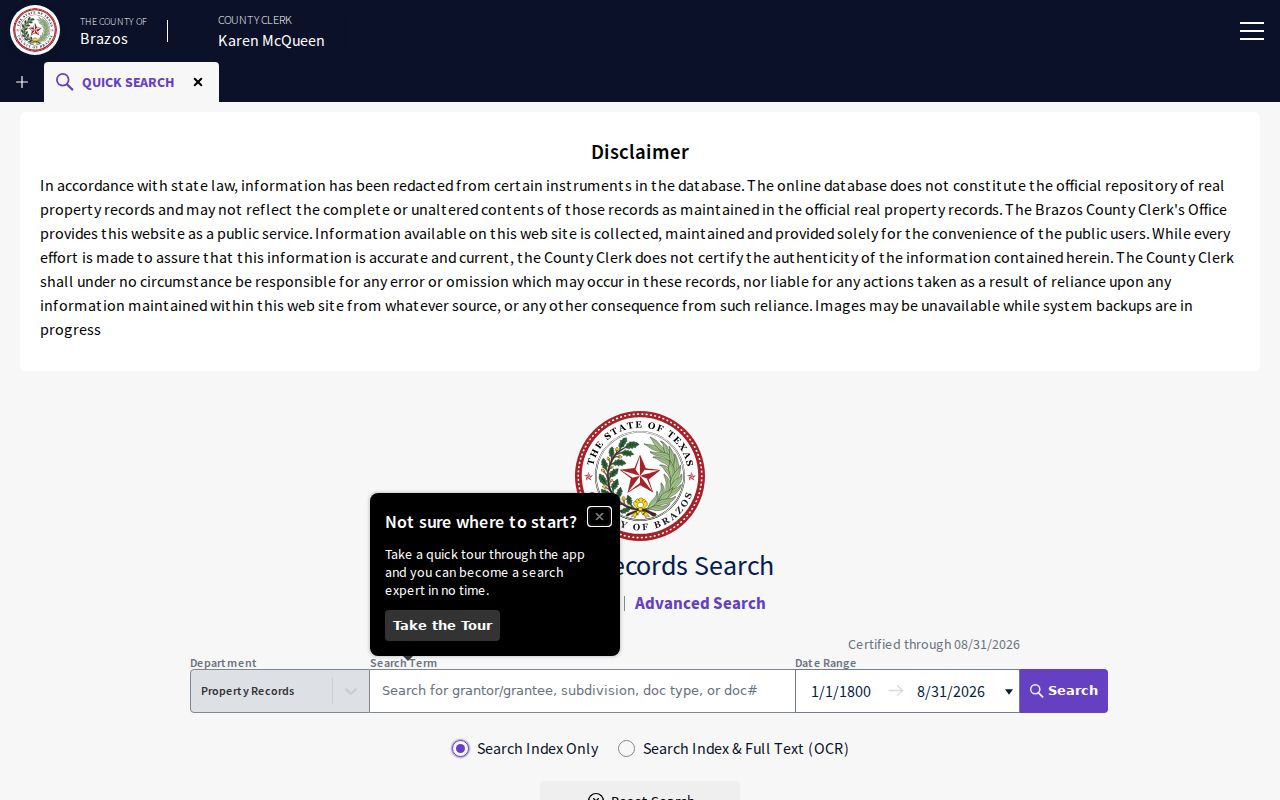
The index image is a starting surface for a chain of title. The important output is a dated sequence of documents and legal descriptions, not a single name attached to a street.
College Station Deed Chain Steps
A College Station chain of title follows recorded interests backward from the present parcel. The sequence should be slow enough to note the difference between execution, sale or consideration, recording, and permit or build dates. Those events can occur at different times. A deed recorded later can make a household look newer than it was.
- Search the CAD owner in the County Clerk index as grantee, using the subdivision and approximate purchase period to narrow a common name.
- Open the purchase deed and note its document number, recording date, grantor, grantee, legal description, return address, plat, and prior-instrument citation.
- Search the seller or grantor as grantee to locate that party’s earlier acquisition. Try middle initials, spouse names, trusts, estates, and the subdivision or lot.
- When a document points to probate, divorce, heirship, a plat, or a trust, move to the custodian for that record instead of forcing the next step to be another ordinary deed.
- When the online path stops, ask the County Clerk about archived books or copies, then use Texas A&M, TSLAC, and FamilySearch routes for the earlier reels.
County Clerk records begin in 1841. The Texas State Library guide identifies deed records from 1841–1886 and deed-of-trust records from 1874–1889 on microfilm. The web portal’s older cutoff remains a research gap, so it should never be described as a complete 1841-to-present search.
College Station Previous Residents Terms
These terms keep a College Station historic address search grounded in the document rather than an assumption about a name.
- Grantor
- The party conveying an interest in a recorded instrument, commonly the seller in a deed.
- Grantee
- The party receiving an interest, commonly the buyer. Searching a grantor as a later grantee is a standard backward-chain move.
- Chain of title
- The documented sequence of recorded interests tied to one parcel or legal description. It is not a legal title opinion.
- Legal description
- The lot, block, subdivision, abstract, league, or metes-and-bounds wording that identifies property in title records.
- Criss-cross directory
- A street-order listing that can place historic names near an address and its nearby entries.
Deeds can be delayed, a plat can reshape a description, and inheritance can transfer property without a conventional sale. The legal description helps prevent a present-day street address from being projected backward without support.
College Station Past Residents in Directories
Ownership is one track. College Station address directories can supply the household track. The local house-history guide says surviving Bryan–College Station directories begin in 1937 and can be searched by name or street address. Texas State Library holdings document runs from 1951–52 through 1994, with gaps. An entry may supply an address and, in some volumes, an occupation or household clue. It can omit people or retain a prior address, so it is evidence to compare, not a final list.
College Station’s Carnegie History Center holds city directories with telephone books, maps, newspapers, and local family collections. Ask staff for the street section and the alphabetical section for the same volume, then preserve the title and page. The fuller shelf and how to read it belong on the College Station city directory page; the address trail uses those volumes to test a specific period.
- Write each spelling, directional form, route, and unit variation for the address.
- Check the street section, then search the name section for the same period and record nearby entries.
- Compare the result with the CAD situs address, a deed’s legal description, and historic imagery or annexation context.
- Pair a directory year with the nearest released census, then use a deed, probate event, permit, or newspaper item to narrow an arrival or departure window.
College Station Previous Residents and Probate
College Station census research uses federal releases through 1950 to provide a dated household and neighbor snapshot, not an annual address list. Census pages are arranged in enumerator visitation order rather than a modern street index. Start with a known name or locality, follow adjacent entries, and allow for rural descriptions or renamed streets. Pair the closest census with a directory rather than expecting the exact modern address to be printed in the same way.
A College Station deed chain can break when property passed through inheritance, marriage, divorce, or a lawsuit. Probate indexes and files can identify heirs, estate inventory, and ownership transfers that a sale deed does not show. Obituaries can add a death date, family, funeral detail, and sometimes a last known address. Carnegie’s NewsBank access reaches local Eagle coverage from 1999 forward, while older Eagle issues are on microfilm. Use an obituary or probate record as corroboration, not sole proof of a residence.
College Station Sanborn Building Clues
The Library of Congress Bryan Sanborn run spans July 1938 through March 1950 on 36 sheets and lists College Station as a secondary location. It gives building footprints, materials, stories, fire walls, street names, and sometimes public or commercial uses. It does not normally name occupants. Its value is testing whether a building or street context existed at the time a directory or deed suggests.
The College Station historical record is a transition story, not a destruction story. County books and reels remain important even with a modern online index. Tax rolls cover 1842–1910, and the 1841 tax roll is cataloged under Navasota County under Nacogdoches County. That odd label can explain an apparent miss. Sanborn, a plat, a directory, and a deed each answer a separate piece of the address question.
Note: Use Sanborn sheets to identify a building and street setting, then rely on dated directories, census pages, deeds, or newspapers for a person connection.
College Station Street Name Changes
A March 23, 1950 Battalion article describes council plans to rename or renumber streets and homes. Proposed examples included Church Avenue becoming Church North Avenue, Foster Avenue becoming Foster East Avenue, and Pershing becoming Pershing South Avenue. The article establishes that a change was planned. It does not provide the final adoption date or a complete official old-to-new crosswalk.
When an older College Station address fails, search the street stem, directional variants, subdivision, lot or block, and nearby names. Compare the city’s historical imagery and annexation resources without silently replacing an old string with a modern one. The final crosswalk remains a research gap that should be stated plainly in a house-history log.
College Station Previous Residents Limits
Previous residents research can describe a documented trail, but it cannot prove every person who ever stayed at an address. A deed party may not have lived there. A directory can omit a person, use an abbreviation, or lag a move. A census is a single-date snapshot. Confidential or protected addresses may be withheld. These limits matter most when a result is tempting but unsupported by a second, independent record.
Lawful use. College Station house-history research is appropriate for family history, estate questions, and personal property curiosity. Never use an address trail to stalk, harass, intimidate, or harm a living person.
Keep the custodian, record date, document or parcel ID, and the source’s own wording with each College Station conclusion. That practice leaves an honest trail for the next researcher and makes uncertainty visible.